


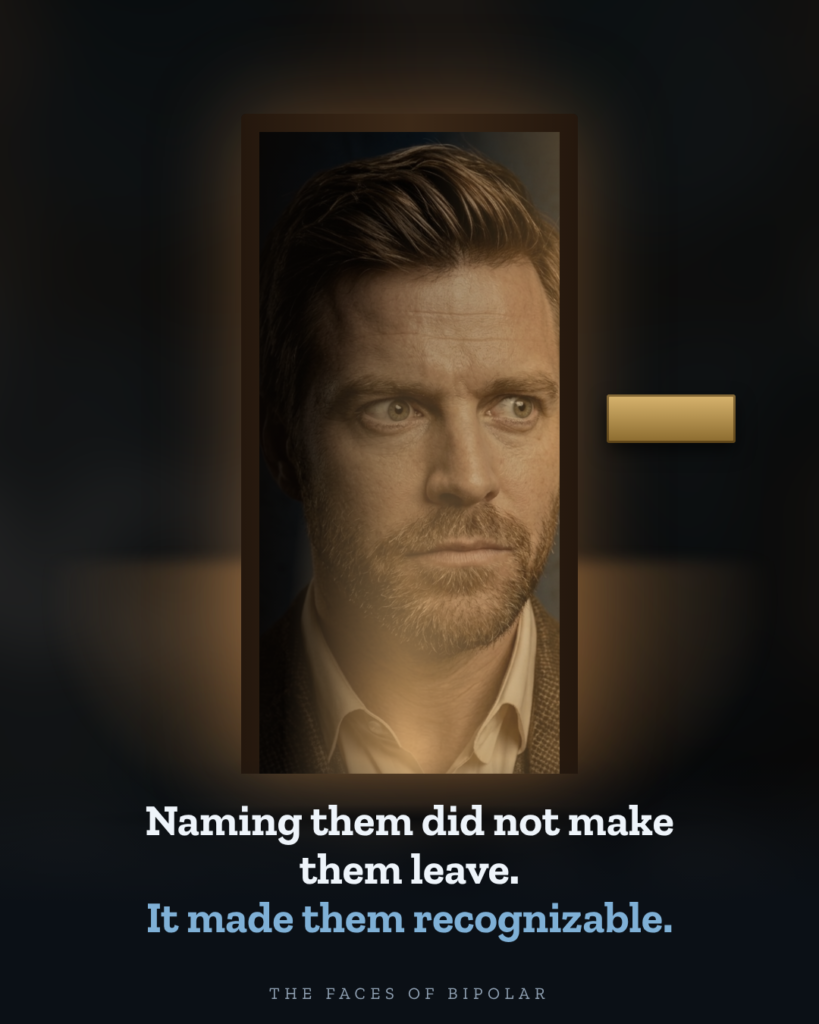
People ask why I use the word personas. It’s a fair question, and a slightly risky one, because the word can sound like I’m claiming something I’m not.
Here’s the honest answer. I tried the standard word first: mood swing. It never described what happened to me. A swing goes up and comes back down. What I lived with was a voice that arrived with its own opinions, its own confidence, and its own plan, and then expected me to carry that plan out.
When I started treating those voices as visitors, I could see them coming. Naming them did not make them leave. It made them recognizable. That one distinction is the reason the book exists, so today I want to explain it properly.
Why “mood swing” never fit
A mood is weather. It comes, it goes, and you wait it out. Calling something a mood swing says the problem is one of size, and the fix is effort: take a walk, get some sleep, think more positively.
That’s not what happened to me. When the thing arrived, it wasn’t a feeling. It was an argument, and the argument was aimed at me. The Antagonist was certain that everyone I loved was working against me. The Liar rewrote history and told me the medication was wrong. Neither one felt like being upset. Both felt like being informed.
The picture most people carry is a quick pendulum, and the research doesn’t match it. In a long follow-up of people with bipolar II, depressive symptoms filled about half of all weeks, and hypomanic symptoms about 1%.¹ In the diagnostic criteria, episodes are counted in days and weeks, not hours. What I lived looked less like a swing and more like long stretches of different weather, each with its own point of view.
I’ve said in the book that calling this a mood disorder is accurate the way calling a wildfire a heat event is accurate. It isn’t wrong. It’s just small. It tells the public the experience is smaller than it is, and it tells the person living it that they ought to be handling it better. That gap kept me from asking for help for years.
A voice with a plan
What made it a voice and not a mood was the plan. A mood doesn’t want anything from you. These did. One wanted a fight. One wanted me off my medication. One wanted me to understand I was a fraud. They arrived in my voice, using my memories, with a confidence an ordinary bad day has never had. Some of what they said even sounded like something I’d needed to say. The distortion was in the volume, the timing, the certainty, and the total absence of a counterweight.
I need to be careful here, because this is where the word can mislead. I’m not telling you I have separate personalities. That’s a different condition with a different name, and I have no business claiming it. There is one of me. Nobody else lives in here. When I say persona, I mean how the thinking arrives: as an argument being made to me, not a thought I’m simply having.
If you do hear voices that are not your own thoughts, please tell your clinician. That’s a separate conversation, and it deserves a professional one.
Naming them did not make them leave
I want to be straight about what naming does and doesn’t do. It doesn’t cure anything. Some days the Antagonist still shows up twenty minutes before dinner. The heavy lifting belongs to treatment: medication, therapy, consistent sleep, and people who know me well enough to say, “that’s not you.” The names sit on top of all that. Not the answer. One of the levers.
What a name changes is whether I can see the visitor at all. I can’t create distance from something I believe is just me having thoughts. Once I can say, “that’s the Critic,” the Critic stops being me for the half second that matters.
The idea is old, and I didn’t invent it. Narrative therapists call it externalizing: describing the problem as something outside you, so it can be examined instead of defended.² Acceptance and Commitment Therapy teaches people to hear a thought as a thought and not as a fact, a skill called cognitive defusion. A 2012 meta-analysis of 66 lab-based studies found that defusion showed a significant positive effect compared with inactive conditions.³ Those studies tested single treatment components, not people with bipolar disorder, so I’d call that support for the move and not proof it works for this illness.
There is also brain research on the simplest version of the step, putting a feeling into words. In a 2007 imaging study of healthy volunteers, naming the emotion in a face reduced activity in the amygdala, a region tied to emotional reactivity.⁴ That doesn’t mean a name tames an episode. It does suggest the instinct isn’t just a trick of language.
The blank nameplate
The image for this post is a doorway in warm light, with a nameplate beside it that is still blank. I think that’s the right picture.
The door is where visitors arrive. The light is warm because this isn’t a horror story, and I don’t want you to read it as one. And the nameplate is blank because the name is yours to write.
Ten is the number I found. It isn’t the number. Yours might be four, or fourteen, or you might skip the word persona and call them weathers or channels or moods with an agenda. Any of that is fine. There’s a practical reason to choose your own, too: a name you chose is a name you’ll believe at two in the morning, and a name you borrowed from somebody else’s book is one the Liar can argue you out of in about four seconds.
If you want to try it, don’t start with the name. Start with the next thought that arrives with an agenda, and write down what it wants. The name can come later, when you’re calm, ideally with someone who knows you. And if naming doesn’t help you, skip it. The point was never my vocabulary. The point is being able to see who is at the door.
If you are in crisis in the U.S., call or text 988.
Notes
- Judd LL, Akiskal HS, Schettler PJ, et al. “A prospective investigation of the natural history of the long-term weekly symptomatic status of bipolar II disorder.” Archives of General Psychiatry, 2003;60(3):261-269. I read the abstract: depressive symptoms in 50.3% of follow-up weeks and hypomanic symptoms in 1.3%.
- White M, Epston D. Narrative Means to Therapeutic Ends. W. W. Norton, 1990. The origin of externalizing in narrative therapy. Cited from general knowledge; I did not open the book.
- Levin ME, Hildebrandt M, Lillis J, Hayes SC. “The impact of treatment components suggested by the psychological flexibility model: a meta-analysis of laboratory-based component studies.” Behavior Therapy, 2012;43:741-756. Sixty-six studies; I read the abstract and record only.
- Lieberman MD, Eisenberger NI, Crockett MJ, Tom SM, Pfeifer JH, Way BM. “Putting feelings into words: affect labeling disrupts amygdala activity in response to affective stimuli.” Psychological Science, 2007;18(5):421-428. Healthy volunteers; an imaging study, not a treatment trial.

Hi, I’m Jeremy.
For five days I’ve been sharing pieces of a book. Today I’d like you to meet the person who wrote it, because a book about the inside of a mind should come from someone willing to say plainly who he is.
Here is the short version. I’ve worked in technology for more than twenty years. I live in North Carolina with my wife, Heather. I take photographs. I live with bipolar disorder. I wrote this book because I would have wanted to read it.
Each of those lines is true, and none of them is the whole story. Let me take them one at a time.
Twenty years of building things
I’m a software engineer who became a manager. I was born in Sedro-Woolley, Washington, a town most people have never heard of, and that felt about right. I graduated high school early, married at eighteen, and finished a computer science degree magna cum laude. Silicon Valley came next, then a move to North Carolina in 2001, a house, and a daughter named Emily.
I start with the career because it shaped how I think, and it shaped how this book is built. I trust what I can observe. When my thinking changes, I log it the way I’d log a system that started behaving strangely: time, symptom, intensity, trigger if I can find one. That habit became the backbone of how I manage this illness. It’s also why the book is full of specifics and short on reassurance. I have very little patience for anything that lies about what it actually does.
The career was also my hiding place. For most of my life, being good at things felt like proof that I was okay. From the outside it looked like a life that worked. On the inside I was holding the walls up with both hands while something behind them quietly cracked. Achievement can look a lot like stability, right up until it can’t.
Heather, a house, and a camera
Heather and I married in 2016. That same year took her father and my mother, both to cancer, so we started out carrying a lot. We live in North Carolina with our blended family. Her name is in the dedication because this book does not exist without her, and over the next 34 days you’ll hear more about her, including the part that’s hard to tell.
I also take photographs. I don’t have a clinical argument about photography and bipolar disorder, and I won’t invent one. What I can tell you is what a camera asks of me. It asks me to stop, look at one thing, and decide what belongs in the frame. That’s close to the skill I’ve had to learn with my own thinking: notice what’s in front of me before I react to it.
There is some research in that neighborhood. A 2020 systematic review of 15 studies found that photography-based methods, mostly photovoice and photo-elicitation, helped people describe their own experience of recovering from mental distress, and may support recovery itself.¹ That is a small body of evidence, and it does not say a camera treats bipolar disorder. I’m not claiming it does. I’m saying I’m not surprised that giving someone a way to show their life, and not only explain it, turns out to matter.
What I live with
I was thirty-nine when a psychiatrist handed me the words bipolar disorder, in 2012. By then it had been running my life, unnamed, for years. A lot of what followed is in the book: adopting my sister’s three children, the end of my first marriage, a breakdown, long-term disability, and ECT. And this year, in a mixed state, a persona I call the Liar sent messages about Heather to my best friend. She read them. I’ve stopped looking for language that makes that smaller than it was.
I don’t tell you this for sympathy. I tell you because it’s true, and because I’d rather you hear it from me before you decide whether to trust the rest.
You should also know I’m not alone in this, and neither are you. According to the National Institute of Mental Health, about 2.8% of U.S. adults had bipolar disorder in the past year and 4.4% at some point in their lives. Among those with past-year bipolar disorder, 82.9% had serious impairment.² Those numbers come from interviews done between 2001 and 2003, so read them as an outline, not a headcount. Even so, that’s a lot of people, and you pass some of them every day.
I’m not a doctor or a therapist. I’m someone who has lived inside this long enough to describe it. My marriage is still healing. I’m still healing. I win more often than I lose.
The book I would have wanted to read
When I got the diagnosis, nobody told me what was coming. I heard about moods and cycles. Nobody said, “There’ll be a version of you that’s looking for a fight and will find one whether or not one exists.” That is the sentence I needed and didn’t get, so I put it in the book.
So I wrote the book I went looking for. It has the clinical language, but from the inside. It has names for the voices, so they’re easier to see coming. It has sections called What Your Clinician Sees, so you have words to say out loud in an appointment. It is not a cure and it is not a manual.
I think the form matters, though I’d hold that loosely. A 2012 study in BMC Psychiatry looked at 44 people newly diagnosed with bipolar disorder who exchanged emails with four trained peer supporters during an online education program. The newly diagnosed gained practical ways to manage the illness and emotional support, and the supporters helped them build better relationships with their mental health services.³ It was small, it was qualitative, and it studied one-to-one conversations, not books. A book isn’t a peer. But someone who has been where you are and tells you the truth about it is doing something close to the same job.
So if you’re in the stretch where nobody has named it yet, or you love someone who is, hi. I’m glad you’re here. If you are in crisis in the U.S., call or text 988.
Notes
- Milasan LH, Bingley AF, Fisher NR. “The big picture of recovery: a systematic review on the evidence of photography-based methods in researching recovery from mental distress.” Arts & Health, 2020. Fifteen qualitative and mixed-methods studies; I read the abstract and record only, not the full text.
- National Institute of Mental Health, “Bipolar Disorder” statistics page (nimh.nih.gov/health/statistics/bipolar-disorder). Figures are from the National Comorbidity Survey Replication, 2001 to 2003: 2.8% past-year prevalence, 4.4% lifetime, and 82.9% of past-year cases with serious impairment.
- Proudfoot JG, Jayawant A, Whitton AE, Parker G, Manicavasagar V, Smith M, Nicholas J. “Mechanisms underpinning effective peer support: a qualitative analysis of interactions between expert peers and patients newly-diagnosed with bipolar disorder.” BMC Psychiatry, 2012;12:196. doi:10.1186/1471-244X-12-196. Forty-four participants and four peer supporters, analyzed alongside a randomized trial.
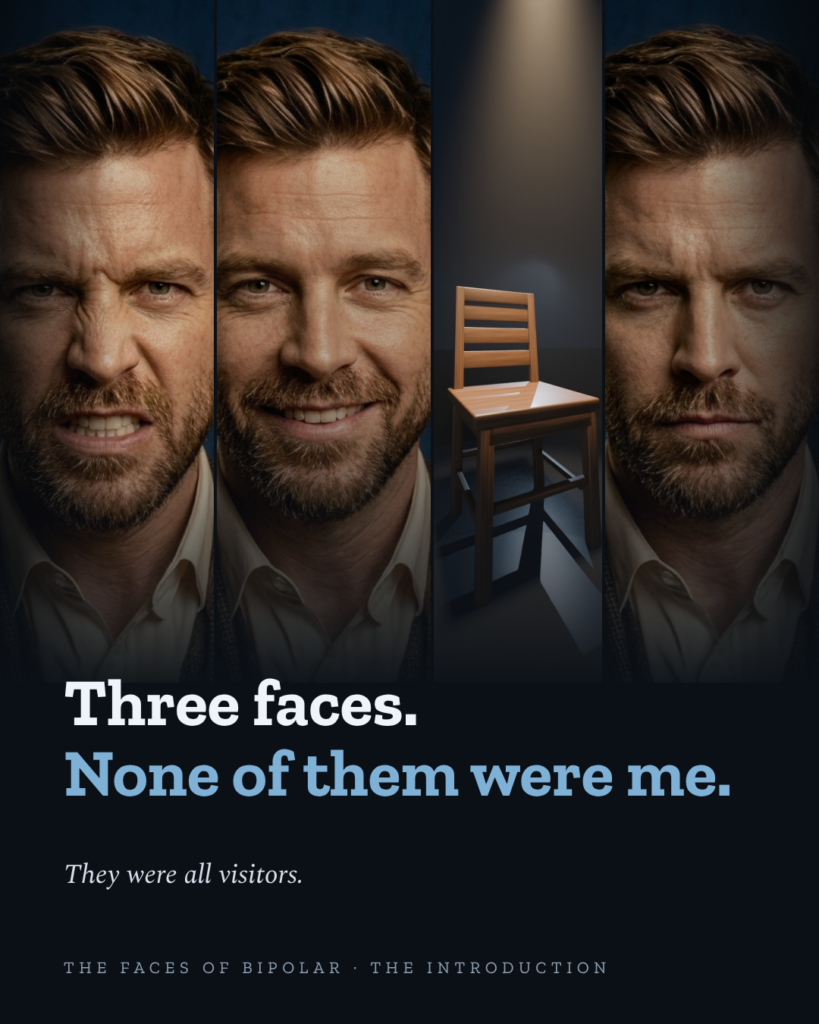
There’s one sentence in the Introduction that changed how I read my own life.
“None of them were me. They were all visitors.”
I wrote it about three versions of myself, and it took most of my adult life to be able to write it. If I had to picture it, I’d draw a long table with three figures seated at it. Each is lit differently. None of their faces are fully visible. And between them sits an empty chair. I’ll come back to the chair.
Three claims on the same seat
For years I thought my job was to work out which of them was the real one. There was the Jeremy who kept driving forward, who graduated magna cum laude and held the walls up with both hands. There was the Jeremy who lay in bed for three days, unable to remember why any of it mattered. And there was the Jeremy who felt invincible, who could see ten moves ahead and didn’t need sleep.
Each one made a case. The driver had the résumé. The low had honesty on its side, because it seemed to be the one who finally saw things clearly. The high had energy and conviction, and it felt like the best version of me, the one I was always supposed to be. All three used my memories, my vocabulary, and my history as evidence.
That’s what makes the question so hard to settle from the inside. Hypomania, especially with extra energy and a good mood, can pass for normal, and people often don’t see it as a problem.¹ And insight tends to be weaker during an active episode than in remission.² The instrument I would have used to decide which one was real was being run by the contestants.
I wasn’t unusual in struggling with this. In a recent interview study of 20 adults with stable bipolar disorder, most of them with Bipolar II, participants described trouble telling which traits were authentically theirs and which were symptoms, especially the confidence and energy of hypomania. One said, “I still don’t know who I am.”³ The study was small, so it can’t tell us about everyone. But it matches what I felt.
What one sentence changed
Before that sentence, my life read like a record kept by a single author with an inconsistent character. The good chapters proved what I could do. The bad ones proved what I wouldn’t. That’s a hard book to read about yourself, and I read it for years.
After it, I started asking a different question of the same record: who was talking? I’m not claiming the illness wrote my whole life. But for the stretches I couldn’t explain, that question opened something that “what is wrong with me” never did. The diagnosis became a way to reread the past. I’m not the only one who found that. Many participants in that same study described diagnosis as a lens for reinterpreting their past and understanding themselves.³
It isn’t always flattering. Some of what I see when I reread is a version of me I wouldn’t have chosen. But a story with the right narrator is easier to live with than a story where everything is a verdict.
“Visitors” is not an alibi
I want to be careful here, because this idea can be misused, including by me.
Calling them visitors doesn’t make the damage go away, and it doesn’t hand me an alibi. When the Liar sent those messages about Heather, the damage was real, and I can’t walk it back by saying the Liar did it. But I also can’t move forward by believing the Liar is the truest version of me. Neither is accurate, and living inside either one will cost you. Both things hold at once: the illness explains it, and I’m still accountable for it.
Not everyone lands on my word, either. In that same study, some participants saw bipolar disorder as a separate entity, some as intrinsic to who they are, and many as somewhere in between. One said, “I don’t separate bipolar disorder from me.”³ I don’t think that’s wrong. My own position is that the illness is part of my ground and the visitors are what it sends. The distance is the point, not the vocabulary.
The empty chair
So who sits in the empty chair?
I think it’s the one who was always there, watching from somewhere behind my own eyes. For years I couldn’t reach that seat from the inside. What changed was learning that I could watch the visitors instead of becoming them. Not always, and not at first. But sometimes, early in an episode, there’s a half second of something that isn’t quite the persona and isn’t quite me. If I catch it, I can name it. That’s the Liar. This thought isn’t mine.
The chair doesn’t belong to any of the three. The person who belongs in it is the one who shows up between episodes. For me, that person solves hard problems, has a real conversation, and makes Heather laugh. When I can’t feel those anchors, that’s data. Participants in the study described a similar path, from struggling to put the experience into words toward naming it and fitting it into their lives.³
If you want to start, do it on a decent day, when nothing is on fire. Write down the voices you actually hear. What each one says, what it wants from you, and what it usually costs. Then show the list to one person who knows you. You might find three. You might find ten. You might prefer to call them weathers or channels. The name isn’t the point. The point is the seat you’re watching from.
If you are in crisis right now, call or text 988 in the US (988 Suicide & Crisis Lifeline). If you are in immediate danger, call your local emergency number.
Notes
- Psychiatric News. Special Report: Bipolar Disorder II – Frequently Neglected, Misdiagnosed. March 2023. Notes that patients may see hypomania, especially with extra energy and good mood, as normal.
- Latalova K. Review of insight in bipolar disorder. Psychiatric Quarterly. doi:10.1007/s11126-011-9200-4. Insight is weaker during an active episode than in remission.
- Ponticiello MN, Chang AL, Chang RJ, Mirza S, Martin A. On being and having: a qualitative study of self-perceptions in bipolar disorder. Frontiers in Psychiatry. 2024;15:1509979 (published January 2025). Semi-structured interviews with 20 adults with clinically stable bipolar disorder, 75% with Bipolar II. The authors note the small sample and snowball recruitment.

Bipolar I and Bipolar II tend to get said in the same breath, so people assume they’re the same illness at two different volumes. They aren’t. They’re two diagnoses with two different roads, and the difference matters.
Before I go further, a few things about where I stand. I’m not a clinician, and this is not a screening tool. It’s the plain-words version, from someone who lives with one of them. I have Bipolar II. What I know of Bipolar I comes from the clinical picture and from people I’ve sat beside, not from my own diagnosis. Only a clinician can diagnose either one.
Bipolar I
Bipolar I is defined by at least one manic episode. A manic episode lasts a week or more, or it is severe enough that hospital care is needed.¹ Depression is common, but it isn’t required for the diagnosis.
Mania is not a great week. It can mean days without sleep and without feeling tired. It can mean spending money you don’t have, with total confidence that it will work out, and making decisions your sober self would never make. Sometimes it means losing touch with reality entirely. In practice the depression usually comes too.
That’s the version most people picture when they hear the word bipolar. It’s also the version that is hardest for the people around you to miss, because the changes are large enough to interrupt a life.
Bipolar II
Bipolar II is mine. It requires at least one major depressive episode, which lasts two weeks or more, and at least one hypomanic episode, which can be as short as four days. There is no full mania.²
Hypomania is the lighter high, and it’s easy to misjudge. From the inside, it feels like finally operating at full capacity. Clear thinking, energy, confidence, creativity, less need for sleep. It doesn’t announce a crisis. It hands you a good week, and the cost shows up later in what you committed to while you felt unstoppable. Then the other half of the diagnosis arrives. Bipolar II depression can be long and heavy.
For me, the high looked like starting things I didn’t finish and making commitments I couldn’t keep. It looked like two-in-the-morning conversations that felt urgent and revelatory to me and did not feel that way to the person on the other end. It looked like financial decisions that seemed, from the inside, like the obvious move of someone finally operating at their true capacity. And through all of it, I felt better than I’d felt in months. Possibly ever.
From the outside, hypomania can pass for a very good stretch. People with Bipolar II often seek help for the depression, not the high, because the high can feel pleasurable.² That’s also why the people around you may notice that something has changed before you do.
Neither is the “mild” one
People hear “II” and assume it’s the milder one. It’s a natural mistake, because the numbering looks like a ranking. It isn’t one.
In a long-running study that followed people with each diagnosis week by week, people with Bipolar I were symptomatic in about 47 percent of weeks. People with Bipolar II were symptomatic in about 56 percent.³ Depression dominated in both, at roughly three to one over mania or hypomania. Bipolar II was long treated as a lesser form of Bipolar I, even though studies show a comparable illness burden.⁴
That framing has done real harm to people who were told theirs was the easier diagnosis, then spent years wondering why it still felt so hard.
Why the label has consequences
This isn’t a debate about vocabulary. The diagnosis steers treatment.
The depressive criteria for Bipolar II are identical to those for major depression, so on the day someone describes the low, the two can look the same.⁴ When a person with Bipolar II is treated as if they have ordinary depression, the missing piece is the high that nobody asked about.
One clinic study from 2000 reviewed the charts of 85 outpatients with mood disorder diagnoses. The authors found that antidepressants were used earlier and more often than mood stabilizers, and that 23 percent of the sample had a new or worsening rapid-cycling course that the authors attributed to antidepressant use.⁵ The study was small and uncontrolled, and it’s old, so I read it as a snapshot of a problem, not a verdict on any medication.
My own road included years on the wrong medication before we found a combination that worked. I’m not going to tell you what to take, and nothing here is a reason to change what you’re taking. Medication decisions belong to you and your prescriber. What I can tell you is that the details you bring them, the good weeks as well as the bad ones, are what let them choose well.
What they share, and who can tell them apart
Both can include mixed states, where manic and depressive symptoms arrive together. Both can speak through personas. I’d put money on the Liar showing up for people with either diagnosis, because it seems to show up for everybody. Sleep is a lever in both.
The line between them isn’t permanent, either. If someone diagnosed with Bipolar II later has a full manic episode, the diagnosis changes. A label is a snapshot of what is known so far.
Part of why it isn’t permanent is that hypomania can tip into full mania, sometimes quickly, and not always in a way you can recognize from the inside. That’s when the account of people who know you matters most. They tend to see the acceleration before you do. Ideas that were interesting yesterday are urgent today. You need less sleep. You talk faster. Everything connects to everything else in a way that’s dazzling from the inside and hard to follow from the outside. If you love someone and you see that pattern, I’ve found the useful move isn’t arguing with the ideas. It’s slowing the pace and asking about sleep.
The difference comes down to duration, severity, and impairment, and to a history you may not see clearly yourself. Was that stretch four days or three? Did it need a hospital? Would someone who knew you have called it a good week or a warning sign? Those are questions for a trained person with your full history, including the good weeks, and with the account of someone who knows you. Reading is how you find words. It is not how you get a diagnosis.
So I’m not asking you to sort yourself into one of two boxes. If something here sounded familiar, bring it to a clinician and let them sort it out. And if you already have a label, treat it as a starting point. Mine was one, and it took work to learn what it actually meant.
If you are in crisis right now, call or text 988 in the US (988 Suicide & Crisis Lifeline). If you are in immediate danger, call your local emergency number.
Notes
- National Institute of Mental Health. Bipolar Disorder. Bipolar I is defined by manic episodes lasting at least 7 days, or manic symptoms severe enough that hospital care is needed.
- American Psychiatric Association. What Are Bipolar Disorders? Thresholds of one week for a manic episode, four days for hypomania, and two weeks for a major depressive episode, the Bipolar II requirement of one of each, and the note that people with Bipolar II often seek help for depression because hypomania can feel pleasurable.
- Judd LL, Schettler PJ, Akiskal HS, et al. Long-term symptomatic status of bipolar I vs. bipolar II disorders. International Journal of Neuropsychopharmacology. 2003;6(2):127-137. Symptomatic in 46.6% of follow-up weeks for Bipolar I and 55.8% for Bipolar II, with depressive symptoms predominating in both at about 3:1.
- Psychiatric News. Special Report: Bipolar Disorder II – Frequently Neglected, Misdiagnosed. March 2023. On Bipolar II long being labeled a lesser form of Bipolar I despite comparable illness burden, and on depressive criteria identical to major depression.
- Goodwin FK, Ghaemi SN, Boiman EE. Diagnosing bipolar disorder and the effect of antidepressants: a naturalistic study. Journal of Clinical Psychiatry. 2000;61(10):804-808. Chart review of 85 outpatients at one clinic. Uncontrolled, with the authors calling for more controlled research.
“I hadn’t figured it out. I just hadn’t been diagnosed yet.”
I wrote that line in the preface of my book, and I’ve come back to it more than almost any other sentence in it. For years I believed I had failed at being steady.
From the outside, my life looked like someone who had it figured out. I graduated high school early, got married at eighteen, finished college magna cum laude, built a career in Silicon Valley, and bought a house in North Carolina. Being good at things had always felt like proof that I was okay. So I kept achieving. I held the walls up with both hands while everything behind them quietly cracked.
The wrong explanation
When you don’t know there is an illness, you have only one explanation left, and it’s you. The good stretches proved what I was capable of, so the bad stretches had to prove what I wouldn’t do. There was the Jeremy who kept driving forward, building things and proving things. And there was the Jeremy who lay in bed for three days, unable to remember why any of it mattered. Both were mine, so I read the gap between them as a verdict on my character.
I treated my life like code that wouldn’t compile, and I kept looking for the line I’d written wrong. It was never in the code I wrote.
When I look back now, I see the Liar, the Antagonist, and the Grandiose Champion operating in circumstances where I thought I was simply making choices. I wasn’t failing a test everyone else was passing. I was working without information about my own brain.
Why it stays hidden
This isn’t unusual, and it isn’t because you weren’t paying attention. There are structural reasons bipolar disorder hides, Bipolar II especially.
People rarely seek help during hypomania. It feels like energy and a good run, so they don’t see it as a problem, or they don’t remember it afterward. They come in when they’re depressed. And the criteria for the depressive side of Bipolar II are identical to those for major depression, so on the day someone describes the low, the two can look exactly the same.¹
The length of the wait shows up in the research. A meta-analysis that pooled the studies on the gap between the onset of bipolar disorder and its management found about 5.8 years, with wide variation between studies.² In the World Mental Health surveys, more than half of adults with bipolar disorder said their illness began in their adolescent years, and fewer than half of the people with bipolar symptoms had received any mental health treatment.³
I was diagnosed in 2012, at thirty-nine. Mine ran longer than the average, but a long wait is the norm. It is not a personal failure.
What the wait costs
I won’t pretend it cost nothing. Researchers have long proposed that episodes can make later ones easier to trigger, and by the time I had a name for what was happening, a lot of kindling had accumulated.⁴
There is also a grief in it that reaches backward. A diagnosis recontextualizes everything before it: the relationships that strained, the decisions that seemed inexplicable, the stretches of time that look different now. Not absolved. Reconsidered. Some of that rewriting isn’t flattering, and I won’t tell you it is.
But reconsidered cuts both ways. For years the story I told myself was about a man who couldn’t hold it together. The more accurate story is that there was something to find, and nobody had found it yet. The diagnosis didn’t make me steady. It gave the instability a name I could argue with, instead of a flaw I had to hide.
If you are in that stretch now
If you’ve spent years believing you’re inconsistent, or too much, or not enough, here is what I’d say to you.
You are not behind. The average gap is measured in years for a reason, and you are standing inside it, not outside it.
I can’t tell you that you have bipolar disorder. I’m not a doctor, and only a clinician who knows your history can answer that. If any of this sounds familiar, let that be a reason to make an appointment, not a conclusion. And here’s what I wish someone had told me. When you go, tell them about the good weeks, not only the bad ones. The stretch where you barely slept and everything worked, the one you remember fondly, is exactly what tends to get left out, and it may be the part that matters most. If someone who knows you well can come with you, bring them. They’ve seen things you can’t.
For years I thought I had failed at being steady. I had not failed. There was something to find, and I’m glad it was found. If it hasn’t been found for you yet, that isn’t your fault, and it isn’t a verdict.
If you are in crisis right now, call or text 988 in the US (988 Suicide & Crisis Lifeline). If you are in immediate danger, call your local emergency number.
Notes
- Psychiatric News. Special Report: Bipolar Disorder II – Frequently Neglected, Misdiagnosed. March 2023. On why hypomania goes unreported, why patients seek help for depression, and why the depressive criteria for Bipolar II match those for major depression.
- Dagani J, Signorini G, Nielssen O, et al. Meta-analysis of the interval between the onset and management of bipolar disorder. Canadian Journal of Psychiatry. 2017;62(4):247-258. Pooled interval of 5.8 years, with high variation between studies.
- National Institute of Mental Health. International Impact of Bipolar Disorder Highlights Need for Recognition and Better Treatment Availability. March 2011. Summary of the World Mental Health survey findings on adolescent onset and treatment rates.
- Post RM. Transduction of psychosocial stress into the neurobiology of recurrent affective disorder. American Journal of Psychiatry. 1992;149(8):999-1010. The kindling and sensitization model.

There are plenty of good books about bipolar disorder. Some of them are excellent, and I’ll point you toward the ones worth reading. Most of them describe the illness from across the desk: the criteria, the spectrums, the scales. That’s the outside-in view, and you need it.
What’s thin on the shelf is the inside-out view. What the illness sounds like in a bipolar brain, what it’s saying, and why it’s saying it. Put the two together and you get something closer to the whole thing than either gives you alone. That’s the gap this book is written for.
What this book is
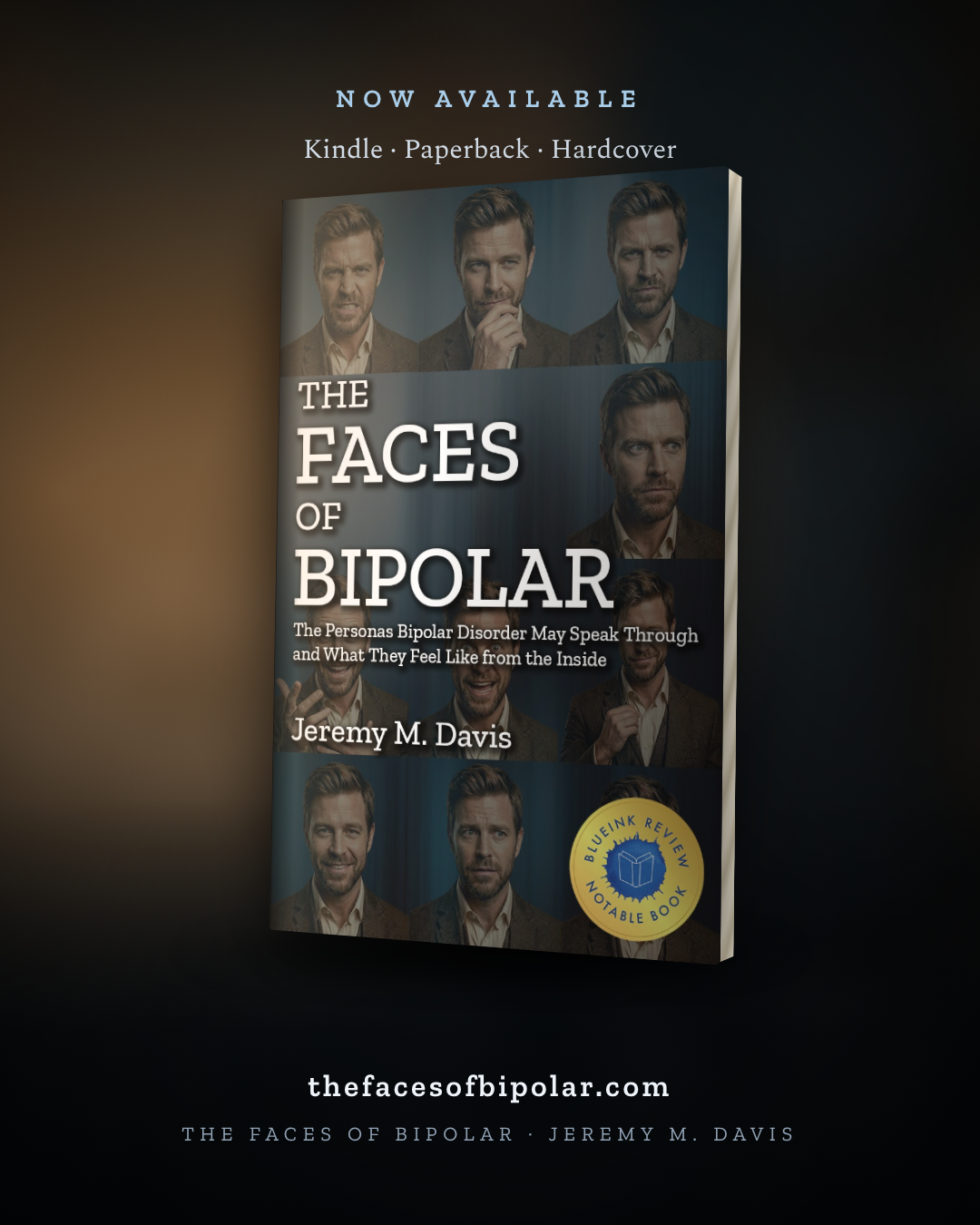
It’s a guide to the personas bipolar disorder can take, explained through my own story. There are ten of them in these pages: the Antagonist, the Liar, the Critic, the Sentinel, the Grandiose Champion, the Stimulant, the Frat Boy, the Encourager, the Scared Child, and the Murderer. For each one I try to answer the same questions. What does it feel like when it arrives? What does it sound like? What does it want? What has it cost me? And how did I learn to recognize it?
The book has four parts. The first covers the diagnosis, the voice, and why “just think positive” is the cruelest thing you can say. The second is the cast itself. The third is about living alongside them, including a chapter for the people who love you and a chapter on treatment. The fourth is about putting the pieces back together. Five appendices sit behind all of that.
One idea runs through all ten personas, and it took me years to see it. They all lie. What differs is how. The Liar fabricates. The Critic barely fabricates at all, because everything it cites is something I actually did, and its lie is in the arrangement. The Scared Child lies about time. Once I understood that, I stopped asking whether a thought was true and started asking what the voice saying it wanted.
Those are my names, and ten is my number, not the number. Yours might be six. Yours might be fourteen. Read for the pattern, not the label.
What it is not
It isn’t a cure. There’s no chapter where I tell you I found the right combination of medications and therapy and now I’m cured. That chapter doesn’t exist. The illness isn’t going away, and a book that said otherwise would be lying to you in the Liar’s voice.
It isn’t a manual. There’s no single road, and anyone who says there is has something to sell you. I was on the wrong medication for years before we found a combination that worked. Your road will look different from mine.
And it isn’t medical advice. I’m not a doctor. I’m not a therapist. I’m a software engineer turned manager who has spent most of his adult life trying to understand why his own brain keeps trying to burn everything down. The medication matters. The diagnosis matters. The people with the training matter, and I’m alive in part because of them. This book is a companion to that work, not a correction of it.
So here is the one instruction I would put in bold if I could. If any page of this book ever leaves you feeling that you don’t need your medication, stop and call your prescriber before you change anything. That feeling is a recognizable move, and the Liar loves a book that agrees with it.
What Your Clinician Sees
Each persona chapter ends with a section called What Your Clinician Sees. I wrote them to keep the book connected to the clinical picture instead of floating free of it, and to give you words for the conversation you have with your own care team.
Here is why that matters. Take anger. A clinician hearing “I’ve been angry” has to work out whether it’s part of a hypomanic state, a mixed state, or the depressive phase itself, because bipolar depression doesn’t always look like sadness. Sometimes it looks like irritability and a hair-trigger. The treatment differs for each. So the useful version isn’t “I’ve been angry.” It’s what triggers it, how long it lasts, whether it comes with energy or exhaustion, and whether your thoughts are racing or slow. The details are the diagnosis.
The stakes of getting those details across are not small. In a survey of 600 members of the National Depressive and Manic-Depressive Association, now the Depression and Bipolar Support Alliance, 69 percent said they had been misdiagnosed, most often with unipolar depression. Those who were misdiagnosed saw an average of four physicians before getting the right answer, and more than a third waited ten years or longer.¹ That survey is from 2000, so read the numbers as a snapshot, not a verdict. But the pattern matches mine: a diagnosis at thirty-nine, after decades of voices I could not name.
Two more things from those sections. Your own account of an episode is often the least reliable data in the room. That’s not because you’re dishonest. It’s because the state distorts self-perception, which is why I keep telling you to bring someone who knows you. And there’s the conversation most people avoid, the one about substance use. Clinicians who treat bipolar disorder aren’t surprised by it. They’re waiting for it.
Understanding your illness is not a substitute for treatment, and I don’t want to oversell what reading can do. But there is evidence that learning about the illness can be part of treatment. In a two-year randomized trial of 50 people with Bipolar I in remission, all of them continuing their medication, 60 percent of those who took a group psychoeducation program had a recurrence, compared with 92 percent of those who did not.² The trial was small and limited to Bipolar I, and a book is not a structured program. I’m not claiming this one does what that program did. I’m saying that learning to describe your own illness precisely is worth the effort.
How to use it
If you have bipolar disorder, read Part One straight through, then go to whichever persona chapter has your name on it. You’ll know which one. If you love someone who does, start with the Introduction and the chapter written for you. If you’re a clinician, take whatever handle one of these names gives the person across from you. It’s yours to use.
Think of the book as a map. It was drawn by someone who walked this ground, and it still isn’t the ground. Your care team has the instruments. Bring them the map and see what you find together.
If you are in crisis right now, call or text 988 in the US (988 Suicide & Crisis Lifeline). If you are in immediate danger, call your local emergency number.
Notes
- Hirschfeld RMA, Vornik LA, Lewis L. Perceptions and impact of bipolar disorder: how far have we really come? Results of the National Depressive and Manic-Depressive Association 2000 survey of individuals with bipolar disorder. Journal of Clinical Psychiatry. 2003;64(2):161-174. Of 600 completed surveys, 69% reported misdiagnosis, with a mean of 4 physicians seen before the correct diagnosis.
- Vieta E, Colom F, Torrent C, et al. Psychoeducation efficacy in bipolar disorders: beyond compliance enhancement. Journal of Clinical Psychiatry. 2003;64(9):1101-1105. Single-blind randomized trial, 25 patients per group, two-year follow-up. Recurrence in 60% of the psychoeducation group and 92% of controls.
For a long time, I could not explain the people I became.
I don’t mean mood swings. When people hear “bipolar,” they picture a pendulum, happy on Monday and sad on Thursday. That is not what I lived. What I lived was stranger. Someone else would speak through me, wearing my face.
The voice used my vocabulary. It knew my history, my fears, and exactly where I was weakest. It sounded like me, and that is the whole trick. You cannot hear the quotation marks around it.
Three Jeremys
I was thirty-nine when a psychiatrist first handed me the words “bipolar disorder.” I felt two things at once. The first was relief. A name meant other people had been here before me. The second was a quiet suspicion that the name was not quite right.
The shorthand most people hear is “mood disorder,” and I turned that phrase over for a long time before I understood why it bothered me. A mood is weather. It passes. If you are in a mood, you will get out of it. What I had been living with did not feel like moods. It felt like different versions of myself showing up uninvited and running things while I watched from somewhere behind my own eyes.
There was the Jeremy who kept driving forward, building things and proving things. I thought he was the real one. There was the Jeremy who lay in bed for three days, unable to remember why any of it mattered. I thought he was the honest one, the one who finally saw clearly. And there was the Jeremy who felt invincible, who could see ten moves ahead and did not need sleep. I thought he was the best one, the one I was always supposed to be.
I was wrong about all three. None of them were me. They were all visitors.
What the textbooks measure
You deserve to understand the machinery, so here is the clinical picture. Bipolar I is defined by manic episodes that last at least seven days, or that are severe enough to need hospital care. Bipolar II, which is mine, involves depressive episodes and hypomanic episodes, a lighter version of the high. A mixed episode has manic and depressive symptoms at the same time.¹
People hear “Bipolar II” and assume it is the milder one. The evidence does not back that up. In a study that followed people with Bipolar II week by week for years, depressive symptoms showed up in about half of all weeks. Hypomanic symptoms showed up in about one percent.² The high is the part everyone notices. The low is where the time goes.
Hypomania is seductive because it rarely wrecks anything right away. From the inside, it feels like finally operating at full capacity. It just makes decisions you will be living with for years.
That is part of why the name takes so long to arrive. A meta-analysis of the research found a pooled gap of about 5.8 years between the onset of bipolar disorder and its management.³ By my own accounting, the voices ran for closer to thirty years before they had a name. The wait matters, because researchers have long proposed that each episode can make the next one easier to trigger.⁴
The voice that does not announce itself
You know the cartoon of the little red devil on the shoulder. You can see it. It sits at a distance and makes its case, and you know it is not your own good judgment. Bipolar is kind of like that but has some notable differences. The voice speaks in first person. It uses your syntax and your memories. When it is running, I do not feel hijacked. I feel like the fog has lifted and I can finally see what everyone else has apparently been seeing all along.
The Liar is the one I know best. It tells me the medication is wrong. It tells me the people trying to help are the problem, and that this certain, unconstrained version of me is the real one. None of it is true. All of it sounds true. That is the whole problem.
Earlier this year, in a mixed state I did not recognize, the Liar picked up my phone and sent messages to my best friend about my wife, Heather. It insulted her. It accused her of things that had no business being said, let alone written down and handed to someone else. She read them. The devastation on her face was real, and so was the damage. The part I still have to carry is that it did not feel like lying. It felt like courage. It felt like finally saying true things.
The Liar does not invent from nothing. It found an old fear of mine, the fear of being left, and amplified it far past any reasonable size. A grain of something real is enough to make the rest taste true.
Why can’t I catch it while it is happening? Because the faculty I would use to check my own state is the faculty the illness affects. Clinicians call this poor insight, or lack of awareness of illness. The research I found says insight is weaker during an active episode than in remission, and weaker in mixed episodes than in purely manic ones.⁵ That is one of the most well-documented features of the illness. It is not a character flaw, and it is not an excuse. It is just the reason I needed people outside my head.
Why I gave them names
I found my ten personas in May 2026, sitting in the wreckage of the worst episode I’d had in a decade. I finally put names to voices I had been hearing for thirty years. The Antagonist shows up full of fury, certain that everyone I love is working against me. The Liar rewrites history. The Critic tells me I’m a fraud. And underneath all of them is the Scared Child, which does not push or fight. It just waits, and it is terrified.
I want to be careful here. I am not telling you I have separate personalities. Nobody else is living in here. There is one of me. What I’m describing is how the thinking arrives. In an episode, the thoughts do not feel like thoughts I’m having. They feel like arguments being made to me. They have an angle. They want something.
Naming a part of the mind so you can look at it from the outside is old, and I did not invent it. Narrative therapists call it externalizing.⁶ Acceptance and Commitment Therapy teaches people to hear a thought as a thought instead of as a fact. There is some brain science pointing the same direction. In a 2007 UCLA imaging study, putting a name to the emotion on a face reduced activity in the amygdala, the brain’s alarm center.⁷ That study was about labeling feelings in photographs, not naming personas, so I won’t claim more than it shows. But it points the same way as what I have lived.
A named thing is easier to see coming. The second I can say “that’s the Critic” is the second the Critic stops being me.
What I want you to take from this
Naming does not make the voice go away. It puts a little space between the voice and my hands, and that space is where my life got better. It took a diagnosis, then treatment, then a lot of unglamorous work. Medication. Therapy. Sleep, which is still the lever I have the hardest time holding. Heather, and the people who will tell me when something has changed. I am not writing from the top of a mountain. My marriage is still healing, and so am I. But I win more often than I lose.
If you live with this, there is a name for what you are experiencing, and you are not the only one who has heard it. If you love someone who does, I am not asking you to excuse anything. I am asking you to understand it. Those are different things. The illness is real and the damage is real, and both have to be held at once.
Over the next several weeks I will share pieces of the book. Some of it is hard. All of it is true. You are not your diagnosis, but it is part of you, and the sooner you know it by name, the sooner you stop letting it run the show without your knowledge.
If you are in crisis right now, call or text 988 in the US (988 Suicide & Crisis Lifeline). If you are in immediate danger, call your local emergency number.
Notes
- National Institute of Mental Health, Bipolar Disorder. Definitions of Bipolar I, Bipolar II, hypomania, and mixed episodes.
- Judd LL, et al. A prospective investigation of the natural history of the long-term weekly symptomatic status of bipolar II disorder. Archives of General Psychiatry. 2003;60(3):261-269. Depressive symptoms in 50.3% of follow-up weeks, hypomanic symptoms in 1.3%.
- Dagani J, Signorini G, Nielssen O, et al. Meta-analysis of the interval between the onset and management of bipolar disorder. Canadian Journal of Psychiatry. 2017;62(4):247-258. Pooled interval of 5.8 years, with high variation between studies.
- Post RM. Transduction of psychosocial stress into the neurobiology of recurrent affective disorder. American Journal of Psychiatry. 1992;149(8):999-1010. The kindling and sensitization model.
- Latalova K. Review of insight in bipolar disorder. Psychiatric Quarterly. doi:10.1007/s11126-011-9200-4. Insight is weaker during active episodes than in remission, and more impaired in mixed episodes than in pure manic episodes.
- White M, Epston D. Narrative Means to Therapeutic Ends. W. W. Norton; 1990. The source of externalizing in narrative therapy.
- Lieberman MD, et al. Putting feelings into words: affect labeling disrupts amygdala activity in response to affective stimuli. Psychological Science. 2007;18(5):421-428.